An international workshop began without a theoretical introduction, without a visible agenda—just a single question:
What inner climate are you bringing into this room today?
There was silence. Not the uncomfortable silence of someone who does not know what to say. The silence of people who, perhaps for the first time in a long while, paused to look inward before looking at the whiteboard.
That moment, which lasted almost ten seconds, turned out to be highly pedagogical. Not because I had said anything extraordinary, but because a well-crafted question does something no explanation can do: it compels people to think. To be present. To connect with their own experience before connecting with the content.
The group consisted of international university educators. Professors with years of classroom experience from different countries, researchers, people with strong academic backgrounds and a genuine vocation for teaching. Yet most of them admitted at the end of the session that they were not making sufficient use of questioning as a valuable and intentional teaching tool.
That brings me to the underlying issue.
Higher education has spent decades talking about critical thinking. It appears in curricula, in transversal competencies, and in institutional discourses about holistic education. Everyone agrees that developing critical thinking is one of the major goals of the 21st-century university.
The problem is not a lack of intention. It is a lack of tools. University educators are not taught how to ask questions. Pedagogical training focuses on curriculum design, assessment, and active learning methodologies. All of that is important, of course, and we should continue along that path. However, there is something more fundamental that comes first and that we need to work on: the quality of the questions we ask in the classroom.
Asking questions seems easy. It is one of the most natural things in the world. And precisely because of that, we fail to give it the attention it deserves. We do not use it consciously, nor do we recognize the enormous difference between a question that opens the door to reflection and one that closes it.
That difference, however, changes everything.
One of the first topics we explored in the workshop was the distinction between good questions and questions that look like questions but are not.
Have you understood? That is not a question. It is an invitation to nod.
Do you agree? Neither is that. It is a request for validation.
Why did you do that? This one has the form of a question, but in coaching (and in the classroom) it tends to generate defensiveness. “Why” seeks justification, not reflection.
The questions that truly activate thinking are open, neutral, and process-oriented. They begin with what, how, who, when, where, and what for. They do not anticipate the answer. They do not contain the questioner’s opinion. They do not seek to confirm what is already known.
Together, we identified 16 types of ineffective questions that appear with alarming frequency in learning environments: the closed question, the double question, the emotionally loaded question, the question that contains the answer, and the question asked merely to fill silence. Recognizing them was, for many participants, their first real moment of awareness.
Because the problem is not that teachers ask these questions carelessly. It is that they ask them without realizing they are doing so. And without awareness, change is impossible.
The good news is that asking good questions can be learned. It is not a natural gift possessed only by exceptional teachers. It is a skill. It can be practiced, refined, and improved over time, just like any other pedagogical competence.
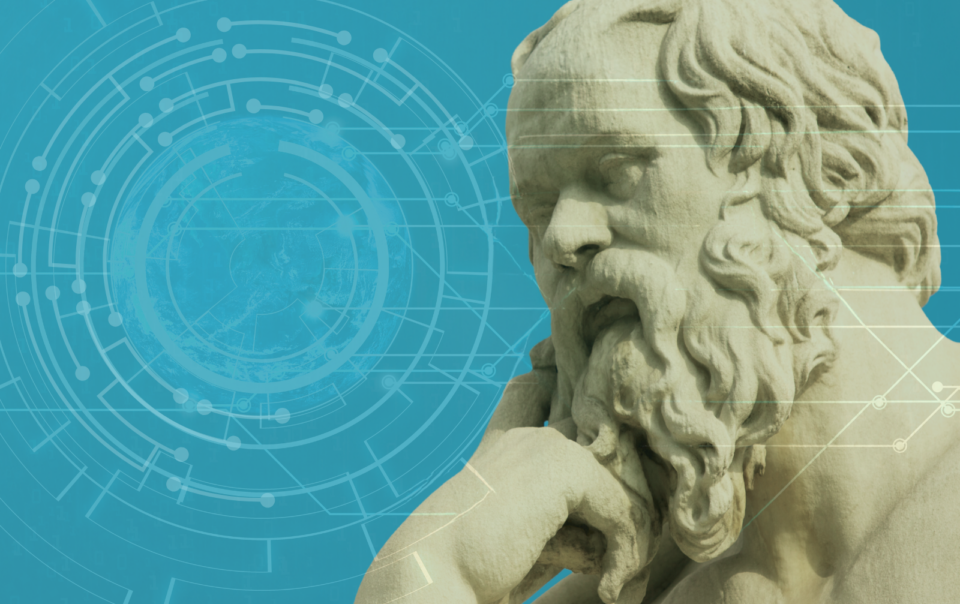
Socrates did not explain. He asked questions.
His method, known as the Socratic method or maieutics, was based on the conviction that knowledge is not transmitted from the outside in but drawn from the inside out. The teacher’s role was not to fill the student’s mind with content but to ask the questions that would allow the student to discover what they somehow already carried within.
The image he used was beautiful: he compared himself to a midwife, as his mother had been. He was not the one giving birth. He was the one assisting the birth.
The birth of ideas.
Two thousand five hundred years later, coaching draws on that same tradition and applies it to human development processes. In coaching, the powerful question is the central tool. Not the only one, but certainly the most transformative. A well-crafted question can change someone’s perspective in a matter of seconds. It can open a possibility that has been closed for years. It can help someone see what they had been unable to articulate.
Today, in the age of artificial intelligence, a new concept is on everyone’s lips: prompt engineering. The art of formulating the right question to obtain the most useful response from a machine.
The irony is striking. We have known for centuries that the quality of the question determines the quality of learning. Now we are rediscovering it because we need to ask a screen the right question.
In education and coaching, this is nothing new. It is called a powerful question. And we have been practicing it long before ChatGPT existed.
One of the things participants value most in workshops like this is leaving with practical tools. Not only with reflections, which are also necessary, but with concrete frameworks they can apply in their very next class.
We worked with three.
The 6Ws of Coaching
Inspired by journalistic practice, this framework proposes building questions around six words: What, Who, How, When, Where, and Why.
The sixth, Why, deserves special mention. In coaching, it is used very cautiously (or often avoided altogether) because it can generate defensiveness. It is frequently reformulated as What for? in order to soften the emotional charge.
This framework is simple, easy to remember, and extremely useful for educators who want to diversify their repertoire of questions without making things overly complicated at the beginning.
Bloom’s Taxonomy
Bloom reminds us that not all questions activate the same cognitive level. A question that asks students to recall a fact is not the same as one that asks them to analyze a contradiction or create a new solution.
During the workshop, I asked participants to think of a concept they teach and write six questions, one for each level of the taxonomy. The result was revealing. Most participants were highly skilled at formulating lower-level questions (remembering, understanding) but much less practiced in designing higher-level questions (analyzing, evaluating, creating).
That is no coincidence. It reflects a system that has historically rewarded the reproduction of knowledge rather than the generation of new knowledge.
The Meta Model of Language
This is perhaps the most sophisticated of the three tools, and also the most powerful in contexts of deep learning. It starts from a fundamental observation: when students speak, they simplify reality. They generalize, omit information, and create false connections between events.
The Meta Model proposes precise questions to reopen what language has closed. When a student says, “I always fail exams,” the conscious teacher’s response is not to encourage them or minimize the statement. It is to ask:
Always? In every exam? Can you think of one occasion when that was not the case?
That question does not contradict the student. It invites them to expand their map of reality. And a broader map always creates more possibilities.
We worked with the three main Meta Model patterns—generalizations, omissions, and distortions—using real classroom examples. The exercise of identifying the pattern and reformulating the question was one of the moments of highest energy in the room
Every time I facilitate a workshop like this, I leave with something I did not have when I entered. This time is no exception.
I take with me the honesty of the group. There is a particular courage in educators who acknowledge that they have been doing something a certain way for years and who aspire to open new possibilities and acquire more resources. When that openness appears, genuine learning becomes possible. And it makes you better. It really is that simple.
I also leave with a conviction that every experience reinforces: university teacher training in communication, listening, and questioning skills is underdeveloped. Not because educators are not good professionals, but because insufficient investment is made in developing the relational skills that allow knowledge to reach learners deeply.
And I take with me the image from the end of the session. I asked the group to think about one question they would ask differently in their next class. There was silence again. But this time it was the silence of someone who already has something concrete in their hands.
That silence is different.
It is the silence of someone who is thinking, not of someone who does not know what to say.
Brazilian educator Paulo Freire said that teaching is not about transferring knowledge but about creating the possibilities for its production or construction.
The question is perhaps the most precise instrument we have for creating those possibilities.
It requires no technology. It requires no major resources. It only requires that the person asking has genuinely decided to listen to the answer.
What was the last question you asked in your classroom, your team, or your conversation this morning that opened something that had previously been closed?
Would you like to bring this workshop to your institution or company? Contact me at obiols@coachingbcn.com or visit www.meritxellobiols.com